

TTR 400 Dehumidifier
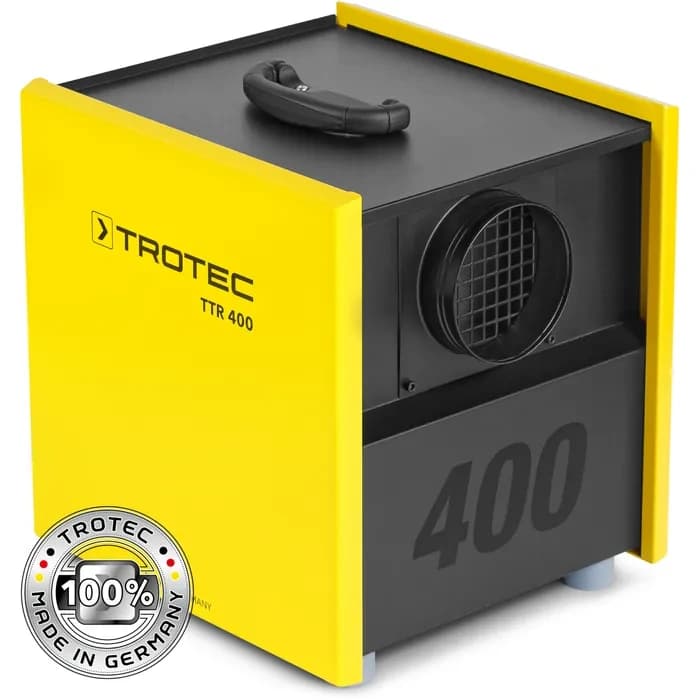
Portable desiccant drying
Direct dry air. Manage moisture.
A portable Trotec desiccant dehumidifier with adjustable dry-air delivery for industrial, storage, and process humidity-control applications.
The Trotec TTR 400 uses a desiccant rotor to remove moisture from air. Its compact steel enclosure and carrying handle suit applications where equipment needs to be positioned around an industrial or storage environment.
Plan the dry-air supply and moist-air exhaust as part of the installation. Share your room conditions, required humidity, and available duct routes with Celsius so the proposed arrangement can be assessed for your application.
- 1.2 kg/hCapacity at 20°C / 60% RH
- 350 m³/hNominal dry-air flow
- 17 kgUnit weight
Built around the airflow
A compact unit with practical control.
The TTR 400 is the standard model in a range that also includes distinct D variants.
Desiccant rotor
Moisture is removed by adsorption, with a separate regeneration airflow carrying the moisture away.
Adjustable dry air
Stepless electronic adjustment lets the dry-air volume be set for the proposed duct arrangement.
Portable enclosure
A powder-coated steel cabinet, handle, and stackable design support movement and storage between jobs.
External control option
The manual describes connection to an external hygrostat or switching device using the appropriate optional connector.
Technical details
Specifications for the TTR 400.
Manufacturer data for the standard TTR 400. Moisture removal varies with inlet conditions and installation.
- Drying technology
- Desiccant / adsorption
- Capacity at 20°C / 60% RH
- 1.2 kg/h
- Dry-air adjustment range
- 130–450 m³/h
- Nominal dry airflow / pressure
- 350 m³/h / 150 Pa
- Nominal regeneration airflow / pressure
- 50 m³/h / 80 Pa
- Intake air temperature
- −15°C to +35°C
- Dry-air / moist-air connections
- 125 mm / 80 mm diameter
- Dimensions / weight
- 400 × 350 × 405 mm (L × W × H) / 17 kg
Installation and operation
Plan the route from humid air to dry air.
Use the manufacturer manual for installation, operation, and maintenance.
Define the duty
Record the space, inlet temperature and humidity, target conditions, and operating pattern.
Arrange the air paths
Confirm the unit position, dry-air connection, regeneration-air supply, and exhaust route before commissioning.
Set & review
Set the agreed airflow and controls, then review environmental readings and filter condition during operation.
Humidity-control applications
Assess the complete drying requirement.
Room volume, moisture load, and air paths all inform suitability.

Storage areas
Discuss a dry-air arrangement around the conditions your stored materials require.

Industrial processes
Review humidity control for a defined working area and its operating conditions.
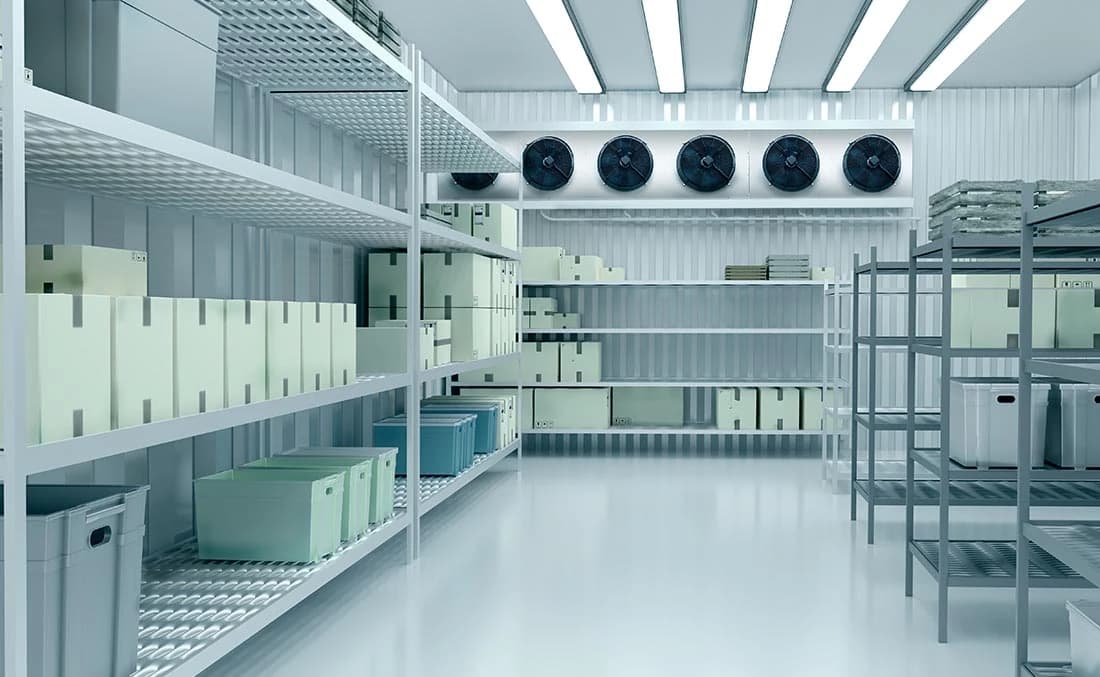
Controlled storage projects
Coordinate the drying duty with refrigeration, room access, and ongoing monitoring requirements.
Product enquiries
Share the space and the moisture load.
Tell us your required humidity, operating temperature, room layout, and available air routes to discuss a suitable installation.
Enquire about this productIs the TTR 400 the same as the TTR 400 D?
No. They are separate models. The standard TTR 400 has a rated capacity of 1.2 kg/h at 20°C / 60% RH. Confirm the exact model before using capacity, control, or electrical data from the shared manual.
Does the unit need a moist-air exhaust route?
Yes. The regeneration airflow carries moisture away from the drying process. Its supply and exhaust arrangement must be planned for the installation, following the manufacturer instructions.