

Munters ML23
Low-humidity process support
Specify the conditions. Select the system.
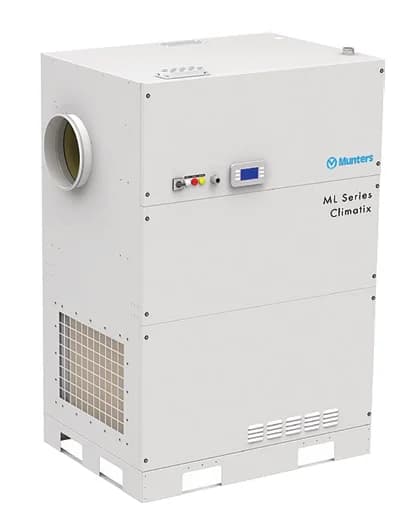
A Munters desiccant dehumidifier with AirC 800 control and a rated process airflow of 2,300 m³/h for industrial low-humidity environments.
The Munters ML23 uses desiccant technology for low-moisture applications. Its current AirC 800 version combines a sealed rotor unit, control functions, and a corrosion-resistant frame and access panels in a stand-alone industrial cabinet.
The correct selection depends on how much moisture enters the environment and the conditions the space must maintain. Celsius can discuss the material or product requirements, existing equipment, and installation constraints before defining the proposed ML23 arrangement.
- 2,300 m³/hRated process airflow
- AirC 800Control system
- 3 alternativesReactivation configurations
Purposeful system design
Coordinate drying, reactivation, and control.
Review the exact ordered configuration alongside the manufacturer documentation.
Desiccant drying
An internally sealed rotor contains separate sections for dehumidification, reactivation, and heat recovery.
Local process control
The current model sheet specifies AirC 800 with alarm functions for the drying process.
Utility options
Electric, steam, and gas reactivation alternatives allow the proposal to reflect the site utilities.
Configurable interfaces
Communication, external controls, and AirC connectivity accessories are options to agree with the system scope.
Technical details
Use ML23 data for the ML23 duty.
Current AirC 800 sheet data. Confirm the electrical and reactivation configuration before installation.
- Technology
- Desiccant dehumidification
- Control system
- AirC 800
- Rated process airflow
- 2,300 m³/h
- Process air available static pressure
- 300 Pa
- Rated reactivation airflow
- 850 m³/h
- Operating temperature
- −20°C to +40°C
- Reactivation alternatives
- Electric, steam, or gas; configuration dependent
Installation planning
Prepare the room, utilities, and air paths.
Selection and commissioning should reflect the intended use of the environment.
Assess the moisture duty
Share temperature and humidity requirements, room use, existing readings, and moisture sources.
Agree the installation
Confirm ductwork, access, reactivation method, utilities, and the controls required by your facility.
Review the conditions
Check operation against the agreed project requirements and plan monitoring and equipment care.
Application planning
Environmental support around your requirements.
The proposed duty determines the equipment and installation scope.

Moisture-sensitive materials
Discuss humidity control around stored materials and handling arrangements.

Production environments
Review a desiccant system for a process area with defined humidity requirements.

Controlled storage
Consider humidity control alongside refrigeration and routine environmental readings.
Product enquiries
Build the proposal around the environment.
Tell us your required humidity, operating temperature, available utilities, and room layout to discuss an ML23 installation.
Enquire about this productHow does the ML23 differ from the MLT30?
They have different airflow and utility specifications. The current sheets rate ML23 process airflow at 2,300 m³/h and MLT30 at 3,000 m³/h. Select the model using the full duty and installation requirements.
What humidity level can it maintain in our room?
The achievable conditions depend on the moisture load, inlet air, room use, and installation. Share those details and the required humidity so the duty can be assessed using manufacturer performance information.