
How mapping reveals temperature variation, informs monitoring locations, and supports qualification and quality records.
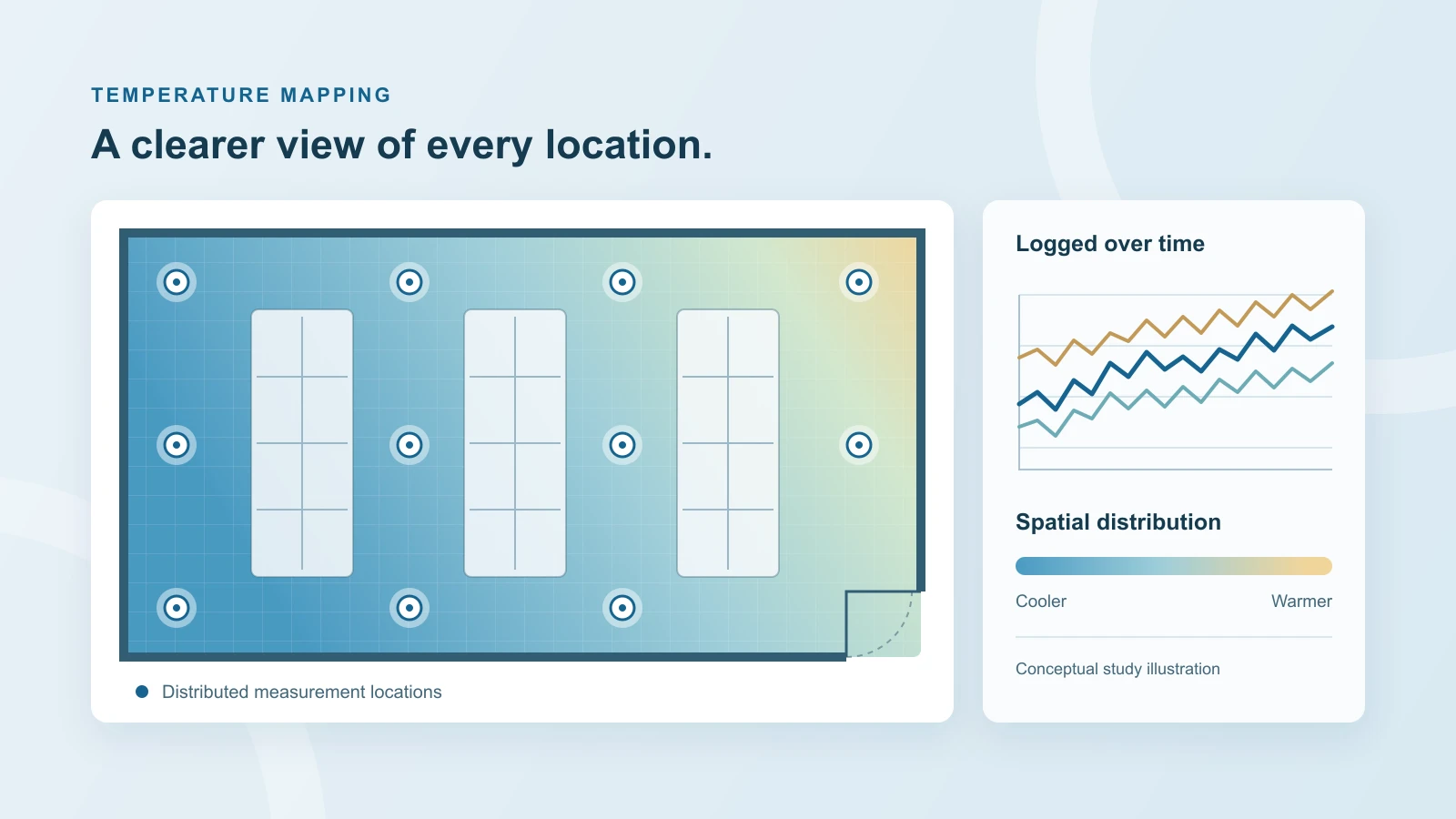
A temperature reading from one location cannot describe conditions throughout a pharmaceutical warehouse or cold room. Thermal mapping shows how temperatures vary across the monitored space and over time, helping teams assess distribution, stability and suitable locations for ongoing monitoring. For food, pharmaceutical and life sciences operations in the UAE, this evidence supports informed decisions about the environments used to store temperature-sensitive products.
What is thermal mapping?
Thermal mapping records temperatures at multiple locations within a defined environment over a study period. The results show how conditions differ across the space and whether the system maintains the conditions required for the products it holds.
A study can identify warmer and cooler areas, reveal uneven temperature distribution and help assess environmental uniformity. Its findings provide a basis for reviewing storage arrangements and selecting appropriate monitoring locations.
Why mapping matters for your cold chain
Temperature-sensitive pharmaceutical products and food commodities need storage environments suited to their requirements. Understanding the actual distribution of temperatures helps operators recognise conditions that may affect product quality and decide where further attention is needed.
Celsius Smart Technical Services LLC provides thermal mapping and validation services in accordance with applicable WHO guidelines and Good Distribution Practice (GDP) principles. The work supports customers’ quality and compliance requirements through evidence about the performance of their storage environment.
How IQ, OQ and PQ support qualification
Following the installation of refrigeration and controlled-environment systems, qualification assesses installation, operation and performance against defined requirements. Each activity addresses a different part of the system’s intended use.
- Installation Qualification (IQ) verifies that equipment and systems are installed in accordance with approved specifications and requirements.
- Operational Qualification (OQ) verifies that the system operates as intended under defined operating conditions.
- Performance Qualification (PQ) evaluates performance under actual or representative operating conditions, including temperature distribution and stability.
A study built around your space
A pharmaceutical warehouse, cold room, refrigerator and freezer each present different conditions to assess. The study should reflect the environment, the system’s intended use and the applicable product and customer requirements.
Celsius works with customers to assess temperature variations and environmental uniformity, then uses the findings to help establish suitable locations for routine monitoring.
- Record temperatures at defined locations to assess variation throughout the space.
- Evaluate the distribution and stability of conditions during the study.
- Identify warmer and cooler areas that require consideration in storage and monitoring decisions.
- Document findings to support qualification and the customer’s review of the environment.
Turning temperature data into action
Mapping results connect recorded temperatures to the locations where products are stored. This helps teams understand which areas perform consistently, where variations occur and which positions are suitable for continued monitoring.
The findings support decisions about the storage environment and provide documentation for quality reviews. Where temperature or humidity control needs attention, refrigeration, dehumidification, maintenance or further assessment may form part of the response.
Continue the picture with real-time monitoring
After installation, qualification and thermal mapping, continuous monitoring helps teams follow conditions during day-to-day operation. Celsius offers real-time temperature and humidity monitoring for pharmaceutical warehouses, cold rooms, refrigerators, freezers and other controlled environments, including solutions such as DicksonOne from the USA.
Depending on the selected system configuration, notifications can be delivered by email, SMS and telephone to support timely responses to environmental changes. Solutions with applicable 21 CFR Part 11-compliant features can support electronic records, data integrity, traceability and audit-readiness requirements when appropriately configured and validated for their intended use.
Bring environmental control and evidence together
Reliable storage brings equipment performance, qualification evidence and routine monitoring together. Celsius provides integrated support across refrigeration, dehumidification, installation, qualification, thermal mapping, calibration and continuous environmental monitoring.
Share the type of environment, products and required conditions with the Celsius team to discuss an approach that supports product quality, operational reliability and applicable requirements.
Key takeaway
Thermal mapping helps establish how a controlled environment performs and where ongoing monitoring should take place. Combined with appropriate qualification, reliable equipment and continuous monitoring, it supports the conditions needed to protect product quality.